My name is Colin McDonnell, and I’m a psychoanalytic psychotherapist and Clinic Director of the Other Clinic.
I am responsible for the clinic’s daily administrative functions, editorial policy, and the clinical standards that shape how the clinic operates.
I hold a Master of Arts in Psychoanalytic Psychotherapy, a Master of Arts in Addiction Studies, and a Bachelor of Arts in Psychology. I am an accredited member of the Association for Psychoanalysis and Psychotherapy in Ireland, a member of the Irish Council for Psychotherapy, and a graduate member of the Psychological Society of Ireland.
I have worked as a psychotherapist for around fifteen years. For twelve of those years, I have also worked as a clinic director, both at the Other Clinic and Psychotherapy Dublin.
Before becoming a psychotherapist, I spent almost ten years working as a care assistant in a hospice. That experience shaped me profoundly. It brought me into close contact with illness, dependency, death, grief, fear, dignity, and the question of what it means to live.
I have also worked across a range of clinical, community, and psychiatric settings, including private practice, hospital services, youth services, addiction services, and community-based services.
Taken together, these experiences continue to shape how I think about life, suffering, diagnosis, therapy, and the difficulty of finding the right kind of help.
Get in touch colinmcdonnell@theotherclinic.ie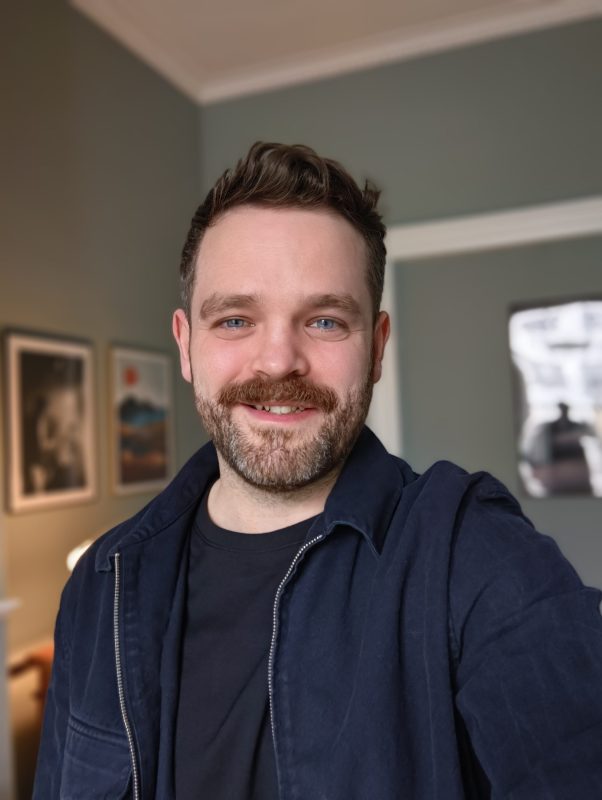

How I came to psychoanalysis
I first studied psychology as an undergraduate with high hopes. At the time, I expected it to bring me closer to the questions that interested me most: why people suffer, how they change, and what actually happens in treatment.
Instead, I found myself dismayed. Much of the course was organised around tests, measurements, studies, probabilities and scientific methods. These things have their place, of course. But treatment itself was never spoken about. A person, in their full particularity, seemed to disappear behind mathematical equations and scientific rigour.
During one class, a lecturer remarked that there was “nothing unique” about any individual.
What he meant was that any description we give of ourselves can also be said by someone else. “I am from Dublin.” “I am a football fan.” “I am a kind person.” “I am anxious.” “I am ambitious.” However personal these statements may feel, they still rely on shared words, roles and categories. No label we identify with truly belongs only to us.
That lecture jarred with me. At the same time, something in it struck a chord.

Why the Other clinic
The name is intentionally ambiguous.
In one sense, it refers to the otherness each person can experience in themselves and in others. Our thoughts, desires, symptoms, identities and relationships are not always fully transparent to us. We often feel alien to ourselves. We can say things we do not quite understand, repeat patterns we do not consciously want, or feel divided between what we believe and what we do.
The name also reflects something about how we think about therapy. The Other clinic was created as an alternative to approaches that move too quickly towards fixed meanings, categories or explanations. Diagnosis and language can be useful, but they should not become a way of closing down the person in front of us.
There is also a psychoanalytic reference in the name. In Lacanian theory, the Other is connected to the social world of rules, expectation and language into which we are born. The ‘little’ other related to something more real beyond what words can describe.
So the name is not meant to be a slogan. It points to the ambiguity at the heart of human experience: that we are shaped by language and by others, while never being fully captured by either. I believe that is where therapy often begins.
Radical singularity
Of course, there is a way in which nobody is unique if we mistake our ideals, labels and images of ourselves for who we are. We inherit words, roles and categories. We speak through language that was there before us. We try to describe ourselves, but language can only ever point towards something. It never captures us fully. It never says exactly what we mean. Nothing ever completely fits.
That, for me, became the point. Not whether a person is unique in some simple sense, but how each person is divided by language, shaped by it, and still never fully contained by it.
Later, during my further studies, I stumbled across a class led by a highly respected psychoanalyst. Those lectures changed everything, but also brought me back to the very beginning.
He spoke about the radical singularity of each person, of people being divided by language, and about treatment as something that must respond to each person’s singularity.
It was something I understood all along while also not quite understanding it.
And that was that.

Clinical Experience
My clinical experience includes fifteen years working as a psychotherapist, twelve years as a clinic director, and almost ten years in hospice care. Here are some of the places I’ve worked.
- Our Lady’s Hospice & Care Services
- Connolly Hospital Blanchardstown
- St. Brendan’s Psychiatric Service
- Stewarts Care Service
- Kilbarrack Coast Community Project
- Dublin Institute of Technology
- Tallaght Youth Service
- Private practice
- Psychotherapy Dublin
- the Other clinic

Selected interviews and publications
Alongside my clinical work, I’ve contributed to public conversations about psychoanalysis, psychotherapy, and mental health through articles, interviews and written reflections. Usually my approach is to distill the theory into something that is universally digestible, but still raises some curiosity.
Irish Times interview on planning funeral arrangements and grief.
Irish Times interview on life coaching.
Irish Country Magazine interview on ‘eating disorders’
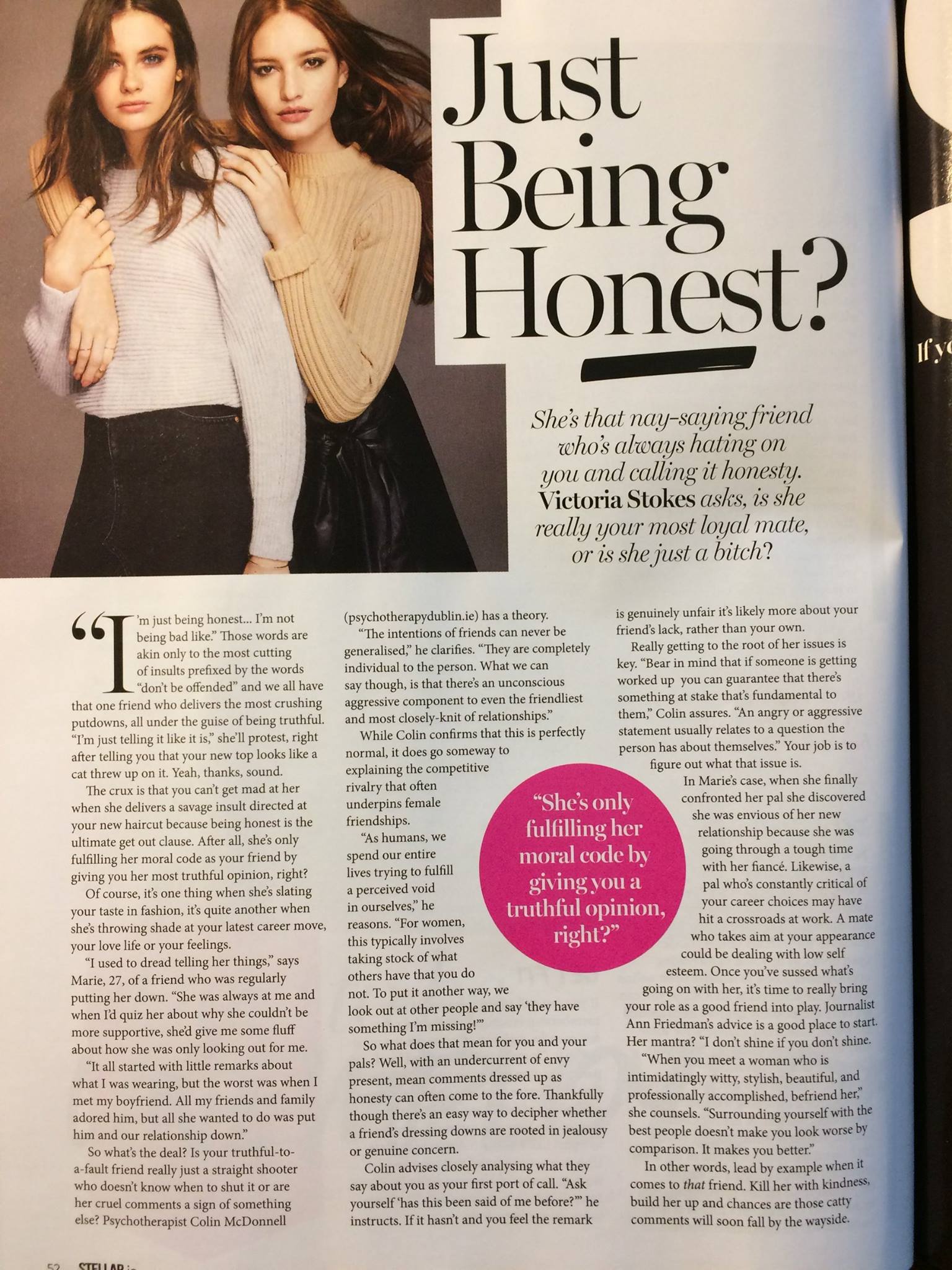
Stellar Magazine interview on honesty
Stellar magazine interview on morning rituals.
Lust For Life: Understanding the Death of Caoilte O’Broin
GCN interview on dangers of AI
Masters Thesis 2014: ‘The Lacanian Symbolic circa 1955: A synthesis of Freud and Lévi-Strauss.’
Masters Thesis 2011: ‘Text or Graphics? An Electrodermal Assessment of Tobacco Health Warnings.’
 Online Therapy
 Eating Disorders & Body Dysmorphia